What Are DMO and DMC? Their Roles, Objectives, and Relationship with MICE Explained
As Japan’s tourism industry experiences a strong recovery driven by inbound demand, increasing attention is being paid to the roles of DMOs and DMCs as key actors supporting sustainable growth and regional economic development. While the terms DMO and DMC are often mentioned in discussions about tourism and MICE, clearly explaining what they are, how they differ, and what functions they perform can be challenging.
This article provides a clear overview of DMOs and DMCs, outlining their respective roles and purposes, and examining how they are positioned within the broader MICE ecosystem.
What Is a DMO (Destination Management Organization)? The Strategic “Control Tower” for a Region
DMO stands for Destination Management/Marketing Organization. In Japan, it is commonly translated as kanko chiiki zukuri hojin, referring to an organization responsible for managing and developing tourism at a regional level. As the term suggests, a DMO functions as a strategic “control tower,” coordinating tourism-related efforts across an entire destination.
A Basic Question: What Does “Destination” Actually Mean?
The term “destination” is an English word that means a “place of arrival” or “intended location.” Its nuance varies slightly depending on the context in which it is used.

In the travel and tourism sector, a destination refers not merely to a physical place, but to a broader travel experience that encompasses local culture, cuisine, activities, and other attractions. In this sense, it represents the overall appeal of a location as a travel destination.

In business contexts, the term may also be used in a metaphorical way to describe a final objective or an intended goal. While the core meaning remains “a place to reach,” its interpretation should be adjusted according to the field being discussed. When used in tourism-related contexts, it is best understood as a “tourism destination” that reflects the comprehensive value and experiences offered by a region.
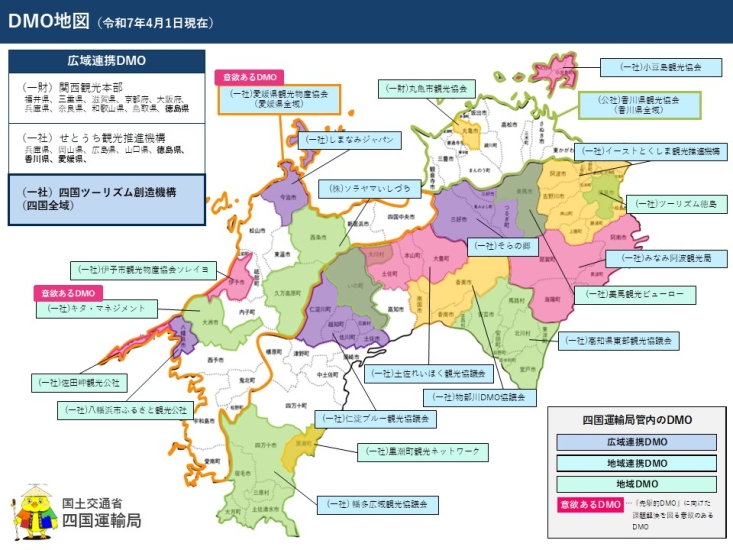
Even within Japan’s Shikoku region alone, there are this many DMOs in operation.
Key Contributions of DMOs
The primary contributions of DMOs can be summarized as follows.
- Data-driven strategy development and brand enhancement
DMOs collect and analyze tourism-related data, such as visitor numbers, spending levels, satisfaction rates, and country of origin. By clarifying a destination’s strengths and challenges, they develop distinctive concepts that resonate with target markets, directly contributing to stronger destination branding. - Consensus-building among diverse stakeholders
DMOs play a coordinating role among a wide range of local stakeholders, including local governments, accommodation providers, transportation operators, restaurants, and residents. By aligning interests and perspectives, they help establish a shared direction for tourism development and promote a unified, region-wide approach. - Enhancement of tourism assets and improvement of the visitor environment
Natural landscapes, cultural resources, and local cuisine are re-evaluated and refined into structured experiential programs. At the same time, DMOs promote improvements to the visitor environment, such as multilingual services, cashless payment systems, and secondary transportation, to ensure a comfortable and seamless travel experience. - Contribution to regional revitalization
Since 2015, the Japanese government has operated a registration system for so-called “Japan-style DMOs” and has promoted their establishment nationwide as a key pillar of regional revitalization policy. DMOs are expected to contribute to revitalizing regions facing population decline by generating economic impact, creating employment opportunities, and fostering a sense of pride among local residents. - Laying the foundation for MICE attraction
In MICE attraction efforts, DMOs work in cooperation with local convention bureaus to promote the bidding and hosting of large-scale international conferences and corporate events. By coordinating venues, accommodation, transportation, and tourism resources, they help establish a reliable hosting framework and enhance the destination’s appeal and credibility as a MICE location.
At present, more than 300 DMOs are active across Japan. Many rely heavily on government subsidies, and challenges remain in securing stable financial resources and developing specialized human capital. At the same time, successful cases are emerging, demonstrating the potential of DMOs to play a sustainable and strategic role in tourism and regional development.
Three Notable DMOs and Their Initiatives
Among the many destination management organizations in Japan, three cases are particularly recognized as successful examples: Setouchi DMO, DMO NAGASAKI, and Hikari no Michi DMO Fukutsu.
Setouchi DMO is a wide-area DMO formed through cooperation among seven prefectures—Hiroshima, Okayama, Kagawa, Ehime, Yamaguchi, Tokushima, and Hyogo. Its initiatives include enhancing the value of regional assets through the “Setouchi Brand Registration System,” operating a membership program to support tourism businesses, and providing financial assistance via the Setouchi Tourism Revitalization Fund. The region has been featured in international media such as The New York Times and National Geographic Traveler, contributing to its growing reputation as a globally recognized destination.
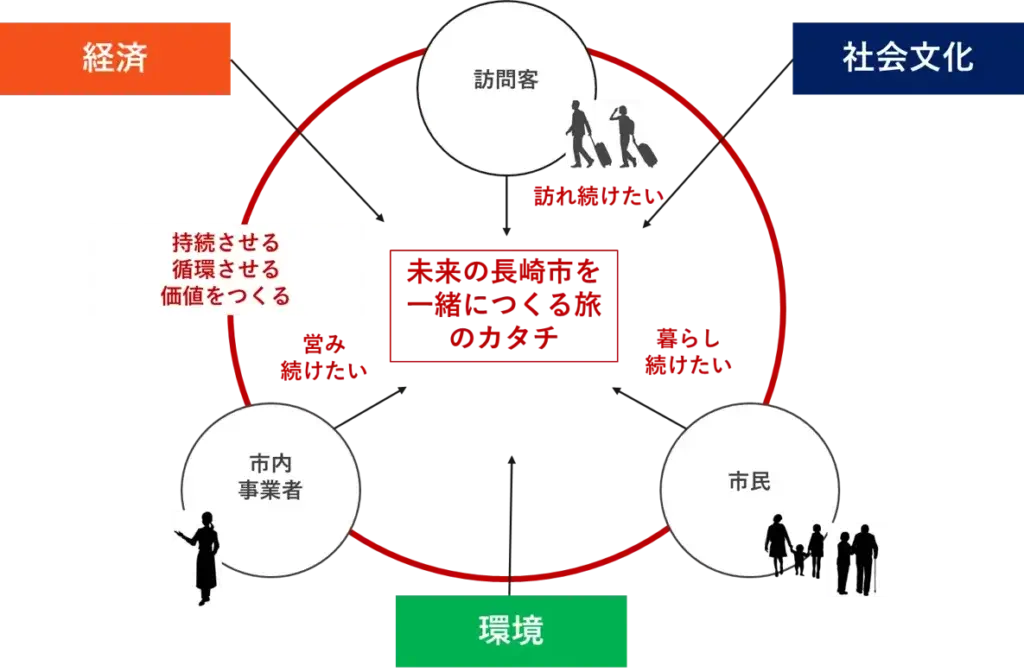
DMO NAGASAKI, formally known as the Nagasaki International Tourism and Convention Association, is based in Nagasaki City and promotes integrated tourism development and regional economic revitalization under the vision of becoming a “chosen city of exchange in the 21st century.” Guided by its unified brand message, “Closer to Everyday Life, the World Is Right There,” the organization conducts strategic promotions grounded in data analysis of visitor trends. Programs that span education, culture, and MICE—such as peace studies and hands-on castella-making experiences—have contributed to higher visitor satisfaction.
Hikari no Michi DMO Fukutsu operates in Fukutsu City, Fukuoka Prefecture, where public and private sectors collaborate to build a regional brand centered on food. By developing tourism offerings that combine accommodation, culinary experiences, and cultural activities, the DMO encourages meaningful interaction between visitors and the local community. With visitor satisfaction exceeding 80% and a repeat visitation rate of approximately 65%, the initiative has attracted nationwide attention as a model for tourism development in regional cities.
Overall, DMOs differ from traditional tourism associations in that they adopt a “destination management” approach grounded in both customer-oriented and management-oriented perspectives. By focusing on maximizing benefits for the region as a whole, DMOs aim to create sustainable value through strategic, data-driven tourism development.
What Is a DMC (Destination Management Company)? The Operational Backbone of MICE
A DMC, or Destination Management Company, is a private-sector organization specializing in the on-the-ground execution of MICE events. Often described as the operational backbone of MICE, DMCs consist of professionals with in-depth knowledge of a destination’s geography, culture, and local resources, playing a critical role in ensuring the success of events held in that location.
Key Contributions of DMCs
- Customized program planning, coordination, and operations
DMCs handle a wide range of practical tasks related to MICE events, including the planning and operation of corporate incentive travel programs, tours associated with international conferences, and distinctive experiential activities. Their scope also covers accommodation and transportation arrangements, as well as on-site event operations. By creating destination-specific experiences that cannot be easily found through online searches, DMCs deliver high levels of participant satisfaction. - High-level expertise and extensive local networks
Leveraging in-depth knowledge of the host destination, along with rich information and local networks, DMCs propose optimal plans based on a thorough understanding of client objectives and participant profiles. This role is particularly critical for inbound groups, as DMCs help bridge differences in language, culture, and regulatory frameworks, enabling smooth and efficient event execution. - Maximizing the economic impact of MICE
Compared with leisure travelers, MICE participants tend to stay longer and spend more per capita. Through concrete program design and operational arrangements—spanning conference management, interpretation services, transportation, printing, and security—DMCs play a vital role in translating MICE activities into tangible economic benefits across a wide range of local industries. - Collaboration with PCOs (Professional Conference Organizers)
In large-scale international conferences, PCOs typically focus on managing the core academic or conference sessions, while DMCs take responsibility for the broader destination experience. This includes pre- and post-conference tours, receptions, events at unique venues, transfers, and accommodation arrangements. Close collaboration between DMCs and PCOs enables both successful conference delivery and enhanced participant satisfaction.
Representative DMCs in Japan include JTB Global Marketing & Travel (JTB GMT), which provides comprehensive support for large-scale MICE events and develops distinctive offerings such as the “ONSEN MICE” concept. Another example is Destination Asia Japan, which is recognized as an international DMC with strengths in delivering high-quality, tailor-made travel experiences, particularly for high-end and incentive groups from Europe and North America.

The Differences Between DMOs and DMCs and the Synergy Created Through Collaboration
DMOs and DMCs have clearly differentiated roles. DMOs primarily function as the strategic leaders of destination marketing, responsible for shaping an overall tourism strategy, enhancing a destination’s appeal, and driving demand. DMCs, by contrast, operate as commercial service providers on the ground, delivering high-quality experiences through the planning, coordination, and operation of concrete MICE programs and travel products. In simple terms, DMOs focus on attracting visitors to a destination, while DMCs focus on delivering hospitality and experiences once visitors arrive.
Rather than competing with one another, these two entities are best understood as complementary partners whose collaboration is essential for success.
- Alignment Between Strategy and Execution
While DMOs create the overarching narrative of why a destination should host MICE events and lead bidding and promotional efforts, DMCs translate that narrative into tangible experiences. By leveraging the destination brand and value proposition established by the DMO, DMCs design and implement concrete programs that demonstrate how participants can enjoy meaningful and memorable experiences in the destination. - Maximizing Contributions to the Regional Economy
When these two functions operate in close alignment, the entire process—from MICE attraction and event delivery to enhanced participant satisfaction—can proceed smoothly, maximizing economic benefits for the region. Promotion alone cannot generate repeat visitation if on-site experiences fall short, and even outstanding programs will have limited impact if they are not effectively communicated. The complementary roles of DMOs and DMCs are therefore indispensable to sustained success. - Building Sustainable Funding Models and Organizational Independence
Many DMOs rely heavily on government subsidies, making the establishment of stable funding sources an ongoing challenge. In response, a hybrid model has emerged in which a DMO also obtains a travel agency license and incorporates DMC functions, often referred to as a “DMC-integrated DMO.” This approach enables the organization to develop and sell travel products directly, generate revenue, and reinvest those earnings into destination promotion and tourism development, creating a more sustainable and self-reinforcing cycle.
Three Notable DMCs and Their Achievements and Initiatives
Japan is home to a wide range of destination management companies (DMCs). Among them, three organizations have delivered particularly notable results in recent years: JTB Global Marketing & Travel, tsunagu Japan Travel, and Essential Japan Travel.
JTB Global Marketing & Travel (JTB GMT) is one of Japan’s largest DMCs and has long supported inbound travel and international event operations. The company provides arrangements and on-site management across a broad range of fields, including incentive travel, educational travel, and MICE. It has successfully delivered accommodation, transportation, and hospitality services for major global events such as the G7 Summit, the Tokyo 2020 Olympic and Paralympic Games, and Rugby World Cup 2019. Its extensive experience and robust network enable stable operations for large-scale projects.
tsunagu Japan Travel is operated by the company behind the inbound media platform tsunagu Japan. Leveraging destination knowledge and networks developed through media content creation, the DMC specializes in tailor-made tours. It places particular emphasis on providing distinctive experiences for individuals and small groups, earning strong support through flexible planning capabilities and attentive on-the-ground execution. A defining characteristic is the close integration between content distribution and travel product development.
Essential Japan Travel is a fast-growing, boutique DMC operating with a lean team structure. Launched in 2020, the company has achieved rapid growth within a few years, handling arrangements for more than 1,500 visitors annually, primarily from European markets. With reported annual revenue of approximately JPY 500 million and gross profit exceeding JPY 140 million, the company has attracted industry attention for achieving high profitability with limited staffing. Its strength lies in efficient booking and operational systems built through close partnerships with European travel agencies.
Although these three companies differ in scale and background, each embodies the core mission of a DMC—delivering unique and high-value experiences to travelers—through distinct approaches. Together, they highlight the diversity and potential of Japan’s tourism industry.
The Roles of DMOs and DMCs in MICE Attraction
MICE—Meetings, Incentive Travel, Conventions, and Exhibitions/Events—generally generates greater economic impact than leisure tourism, as participants tend to stay longer and spend more per capita. To successfully attract and deliver high-value MICE events, close collaboration between DMOs and DMCs is essential.
- The Role of DMOs
DMOs function as the strategic leaders of MICE attraction efforts. Working in coordination with local governments and tourism authorities, they develop bidding strategies and present comprehensive proposals to event organizers. These proposals typically highlight regional venues, accommodation capacity, transportation infrastructure, tourism resources, and available public-sector support. DMOs also work to enhance the credibility and appeal of a destination by improving the MICE hosting environment, including multilingual services, free Wi-Fi, transportation guidance, and the identification of unique venues. - The Role of DMCs
Once a MICE bid is secured, DMCs take the lead in on-site operations. Their responsibilities include registration management, venue setup, audiovisual arrangements, planning of networking events and receptions, coordination of interpreters and guides, and the delivery of inspection or excursion programs. In inbound MICE in particular, DMCs play a vital role in bridging differences in language, culture, and regulatory frameworks, enabling smooth operations and high participant satisfaction. Their flexibility and creative management capabilities make them a trusted partner for event organizers.
The Future of DMOs and DMCs and the Outlook for Japan’s MICE Industry
The Osaka–Kansai Expo in 2025 represents a significant opportunity for Japan’s MICE industry to make a major leap forward. By leveraging infrastructure improvements associated with the Expo and heightened international attention, deeper collaboration between DMOs and DMCs is expected to strengthen Japan’s competitiveness as a MICE destination of choice on the global stage.
Looking ahead, three key themes are likely to play a decisive role in the success of the MICE industry.
- Sustainability
Consideration for environmental and social impact is increasingly becoming a standard requirement in MICE events. Initiatives such as CO₂ offsetting, paperless operations, the use of recyclable décor, and catering options that emphasize local sourcing or accommodate vegan preferences are now integral to the delivery of sustainable MICE. These practices are no longer optional but are steadily being incorporated as baseline expectations. - Digital Transformation (DX)
Technology continues to significantly enhance the value of the MICE experience. The establishment of hybrid MICE formats that combine online and in-person participation, along with the use of VR and AR technologies and event applications, is reshaping how events are planned and experienced. Digital transformation enables greater accessibility, engagement, and operational efficiency across the MICE value chain. - Utilization of Unique Venues
The use of unique venues—such as historic buildings, museums, temples, shrines, and gardens—offers participants memorable experiences rooted in the character of the destination. These distinctive spaces can leave a lasting impression and differentiate a MICE event from those held in conventional facilities.
In addition, growing attention is being given to the concept of “Area MICE,” which utilizes multiple venues across a defined district rather than relying on a single large facility. Urban Area MICE initiatives implemented by DMO Tokyo Marunouchi have demonstrated how encouraging participants to move through and engage with a city can extend economic benefits across a wider area.
Ultimately, the future of regional destinations and MICE in Japan depends on a strong partnership between DMOs and DMCs. DMOs prepare the stage by shaping the destination and articulating its value, while DMCs deliver compelling experiences that engage and satisfy MICE participants on the ground. How effectively these two functions align and operate in concert will determine Japan’s ability to create distinctive, competitive, and sustainable MICE destinations in the years ahead.
Related Articles:MICE Basic

-
What Is a FAM Tour? Its Value, Practical Benefits, and How to Implement It Effectively — with a Focus on MICE

-
Pokémon’s First Outdoor Theme Park, PokéPark KANTO, to Open in Spring 202626-Hectare Facility Planned Within Yomiuriland